
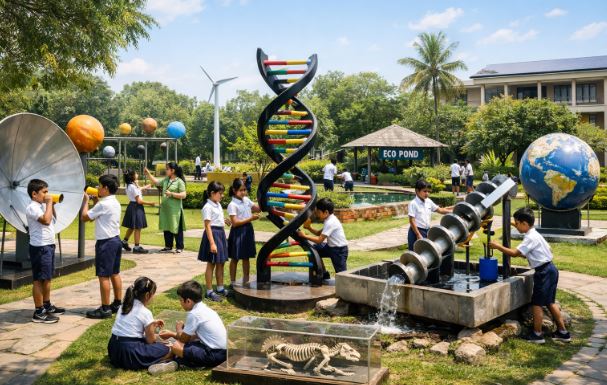
Science is best understood when students can see it, touch it, and experience it in real life. Reading from textbooks gives knowledge, but learning becomes meaningful when ideas are explored practically.
This is where a science park plays an important role in school education. A science park creates an open learning space where students can explore scientific concepts through real models and activities.
In India, many schools are now developing science parks to make learning more engaging and student friendly. This guide explains the science park concept in simple language so that school students can clearly understand its purpose, value, and impact on learning.
What Is Science Park?
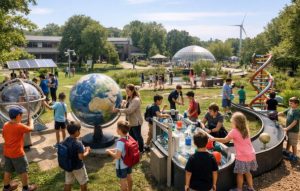
A science park is a specially designed learning area that allows students to understand scientific concepts through practical and visual methods. Unlike traditional classrooms, a science park is usually built in an open or semi open space within a school campus.
It contains working models related to physics, chemistry, biology, mathematics, and environmental science.
The main aim of a science park is to help students learn by observation and interaction. Instead of memorising formulas or definitions, students see how scientific principles work in real situations. For example, models related to energy, motion, water conservation, or sound help students connect theory with reality.
In Indian schools, science parks are becoming an important educational tool because they support experiential learning. They encourage curiosity, questioning, and exploration.
A science park also promotes self learning, as students can interact with the models at their own pace and understand concepts naturally.
Why Is a Science Park Important for School Students?
A science park makes learning meaningful by turning classroom lessons into real life experiences. It encourages students to explore, observe, and understand scientific ideas in a natural and engaging way.
A science park supports overall student development in the following ways:
- Encourages active learning: Students participate directly with models and experiments, which helps them understand concepts better than passive listening.
- Builds curiosity and scientific thinking: By observing how things work, students begin to ask questions and search for logical explanations, developing a scientific mindset early.
- Supports different learning styles: Visual learners benefit from demonstrations, while hands on learners gain from interactive activities, making learning inclusive.
- Reduces fear of science subjects: When science is experienced practically, complex topics in physics and chemistry become easier and more enjoyable.
- Improves confidence and interest: Students feel more confident when they understand concepts clearly, which increases their interest in science subjects.
This approach helps students connect theory with practice and develop a long lasting interest in science.
How Does a Science Park Help in Practical and STEM Learning?
Science parks strongly support practical learning and STEM education. STEM focuses on science, technology, engineering, and mathematics, and science parks bring these subjects together in a real world context.
Through working models and experiments, students understand how scientific principles are applied in daily life. Concepts like energy transfer, force, pressure, and environmental balance become easier to understand when seen in action.
Science parks also encourage problem solving and critical thinking. Students observe how models work, identify patterns, and relate them to classroom lessons. This strengthens analytical skills and logical reasoning.
In addition, science parks promote innovation and creativity. Students are inspired to build their own models and experiments, which helps them think independently and explore new ideas.
What Types of Activities and Models Are Found in a School Science Park?
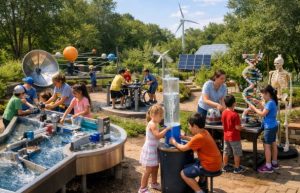
A school science park includes a variety of models and activities designed to explain scientific concepts clearly. These models are usually simple, durable, and safe for students.
Common science park models include demonstrations related to energy, motion, sound, light, water management, and environmental conservation. Biology related models may explain the human body, plant life, or ecosystems.
Some science parks also include weather instruments, solar energy models, and rainwater harvesting systems. These help students understand sustainability and environmental responsibility.
Important activities in a science park may include:
- observing how a model works
- discussing observations with teachers
- recording findings in notebooks
These activities make learning interactive and meaningful without overwhelming students.
How Are Science Parks Different from Science Museums and Labs?
Science parks are different from science museums and science laboratories in several ways. A science laboratory is usually used for controlled experiments under teacher supervision. A science museum focuses on display and observation.
A science park combines both learning and interaction in an open environment. Students can freely explore models without strict time limits or formal procedures. This freedom encourages curiosity and self directed learning.
Science parks are also designed specifically for school students, keeping their age and curriculum in mind. The models directly relate to what students learn in classrooms, making it easier to connect theory and practice.
Another difference is accessibility. Science parks are located within school campuses, allowing regular use instead of occasional visits.
How Are Science Parks Being Used in Indian Schools Today?
In India, science parks are becoming an essential part of modern school education. Many schools are building science parks to support activity based learning as recommended by educational boards.
Science parks are used during regular classes, project work, and science club activities. Teachers use them to explain difficult concepts in a simple way. Students also use science parks for group discussions and peer learning.
In rural and urban schools alike, science parks help bridge the gap between theory and practice. They also support community based learning, where parents and local communities participate in science activities.
The growing focus on innovation and practical education in India has increased the adoption of science parks across schools.
How Can Schools Build an Effective Science Park for Students?
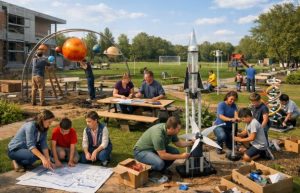
Building an effective science park requires proper planning and educational vision. Schools must first identify key concepts from the curriculum that can be explained through models.
Safety is an important factor. All models should be child friendly and weather resistant. Clear instructions should be displayed so students can use the models independently.
Teachers play a crucial role in guiding students and connecting science park activities with classroom lessons. Regular maintenance and updates ensure the science park remains relevant and engaging.
Involving students in designing and improving the science park also increases ownership and interest in learning.
Conclusion
A science park is more than just a learning space. It is a powerful educational tool that makes science simple, enjoyable, and meaningful for school students.
By encouraging hands on learning and curiosity, science parks help students understand concepts deeply and develop essential life skills.
In Indian schools, vaps science parks support modern education goals by promoting experiential learning and scientific thinking. When used effectively, a science park can inspire students to explore, question, and innovate, making science a subject they truly enjoy.
FAQs
How does a science park improve students interest in science?
A science park improves interest by allowing students to interact with real models, making learning enjoyable and reducing fear of complex concepts.
At what age should students start learning in a science park?
Students can start learning in a science park from primary classes, as models can be designed to suit different age groups.
Can science parks support the school curriculum?
Science parks support the curriculum by visually explaining textbook concepts and strengthening practical understanding.
Are science parks suitable for both rural and urban schools?
Science parks are suitable for all schools as they can be adapted based on space, budget, and student needs.
What skills do students develop through science park learning?
Students develop observation skills, critical thinking, creativity, teamwork, and problem solving abilities.