
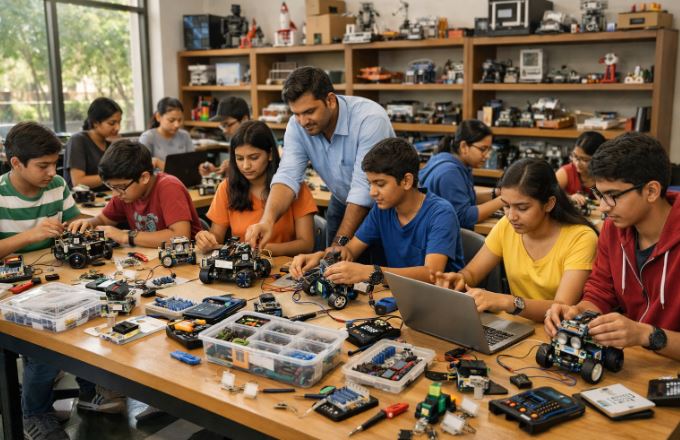
Robotics labs are becoming an essential part of modern education as schools increasingly integrate technology into learning. These labs provide students with hands-on opportunities to explore science, engineering, and programming in an interactive environment.
Instead of only learning theories from textbooks, students can experiment, build, and innovate using real tools and robotic kits. Robotics labs help nurture creativity, problem-solving skills, and logical thinking among students from an early age.
By exposing students to robotics, schools prepare them for future careers in technology-driven industries while making learning engaging, practical, and highly motivating.
What is a Robotics Lab in Schools?
A robotics lab is a dedicated learning space where students design, build, and program robots using electronic components, sensors, and coding platforms. It allows them to apply concepts from science, mathematics, and technology through practical experimentation.
Key Features of a Robotics Lab
- Robotics kits and programmable controllers
- Sensors, motors, and microcontrollers
- Coding platforms and simulation tools
- Hands-on project-based learning environment
- Collaborative learning spaces for teamwork
How Do Robotics Labs Benefit School Students?
1. Enhances Practical Learning
Robotics labs help students move beyond theoretical learning and engage in practical experimentation. When students build and program robots, they see how concepts from physics, mathematics, and engineering work in real life.
This hands-on learning improves their understanding and retention of complex subjects. Instead of memorizing formulas, students apply them while designing mechanisms, controlling motors, or solving technical problems. Robotics projects encourage experimentation, where students can test ideas, make mistakes, and learn through iteration.
Such an environment promotes curiosity and encourages students to explore technology independently. Practical exposure also builds confidence as students witness their ideas turning into functional robotic models.
2. Develops Critical Thinking and Problem-Solving Skills
Robotics projects challenge students to analyze problems and design logical solutions. While building robots, students encounter various obstacles such as coding errors, sensor failures, or mechanical issues. Solving these problems requires logical reasoning, testing, and continuous improvement.
This process trains students to think critically and approach challenges systematically. Robotics also encourages trial-and-error learning, where students learn that failure is part of innovation.
By debugging programs or adjusting mechanical designs, students develop resilience and analytical thinking. These skills are highly valuable not only in technology fields but also in everyday life situations that require decision-making and creative problem-solving.
3. Encourages Creativity and Innovation
Robotics labs provide students with the freedom to design and create unique projects. Students can build robots for tasks such as obstacle avoidance, line following, or object detection, and even invent their own robotic solutions for real-world problems. This creative freedom encourages innovation and imaginative thinking.
Students learn how to combine technology, engineering, and creativity to produce functional prototypes. Robotics also allows students to experiment with different designs and programming approaches, which strengthens their creative confidence.
As students develop their own projects, they learn to transform ideas into practical innovations, inspiring them to pursue future careers in engineering, artificial intelligence, and technology development.
4. Improves STEM Education
Robotics labs play a major role in strengthening STEM education—Science, Technology, Engineering, and Mathematics. Robotics projects integrate all these subjects into a single learning activity.
For example, students use mathematics for calculations, science for understanding motion and sensors, engineering for building structures, and programming for controlling robots. This integrated learning approach helps students understand how different subjects work together in real-world applications.
Robotics makes STEM subjects more engaging and easier to understand because students learn through experimentation rather than memorization. As a result, students develop a deeper interest in science and technology, encouraging them to pursue advanced studies and careers in STEM fields.
5. Builds Teamwork and Collaboration Skills
Robotics labs encourage collaborative learning where students work together in teams to design and build projects. Team-based robotics activities teach students how to share ideas, divide responsibilities, and work toward a common goal. During robotics competitions or projects, students learn communication skills, leadership, and cooperation.
They must discuss strategies, troubleshoot problems collectively, and combine different skills to complete tasks. This collaborative environment mirrors real-world engineering and technology workplaces where teamwork is essential.
Students also learn to respect diverse perspectives and appreciate the strengths of their teammates. Such experiences help build social skills and prepare students for collaborative professional environments.
6. Prepares Students for Future Careers
Technology is rapidly shaping the future workforce, and robotics education equips students with skills relevant to emerging industries. Robotics labs introduce students to coding, artificial intelligence concepts, automation, and engineering design, skills that are increasingly in demand.
Early exposure to robotics helps students develop interest in fields such as robotics engineering, software development, data science, and mechatronics. Robotics projects also encourage innovation and entrepreneurship by allowing students to design solutions to real-world challenges.
By learning robotics in school, students gain a competitive advantage and develop technological literacy that prepares them for higher education and future careers in the digital economy.
How Schools Can Effectively Use Robotics Labs?
Schools can maximize the benefits of robotics labs by integrating them into the regular curriculum and extracurricular activities.
Best Practices for Schools
- Introduce robotics from middle school levels
- Conduct project-based robotics workshops
- Encourage participation in robotics competitions
- Integrate robotics with STEM subjects
- Provide teacher training for robotics education
Conclusion
Robotics labs are transforming traditional education by making learning interactive, practical, and future-focused. They help students develop essential skills such as critical thinking, creativity, teamwork, and technological literacy.
By engaging students in hands-on projects, robotics labs connect classroom theories with real-world applications, making STEM education more meaningful and exciting.
As technology continues to shape modern industries, robotics education equips students with the knowledge and confidence needed to thrive in the digital age. Schools that adopt robotics labs are not only enhancing academic learning but also preparing students to become innovative problem-solvers and future technology leaders.
Frequently Asked Questions
What is the main purpose of a robotics lab in schools?
The main purpose of a robotics lab is to provide hands-on learning where students can design, build, and program robots while applying STEM concepts.
At what age can students start learning robotics?
Students can start learning basic robotics concepts from around 8–10 years old with beginner-friendly kits and simple programming tools.
Do robotics labs require advanced coding skills?
No, beginners can start with visual programming platforms and gradually learn advanced coding as they gain experience.
Are robotics labs only for students interested in engineering?
No, robotics helps all students develop problem-solving, creativity, and teamwork skills useful in many careers.
How do robotics labs make learning more engaging?
Robotics labs make learning interactive by allowing students to build projects, experiment with technology, and see real results from their work.