
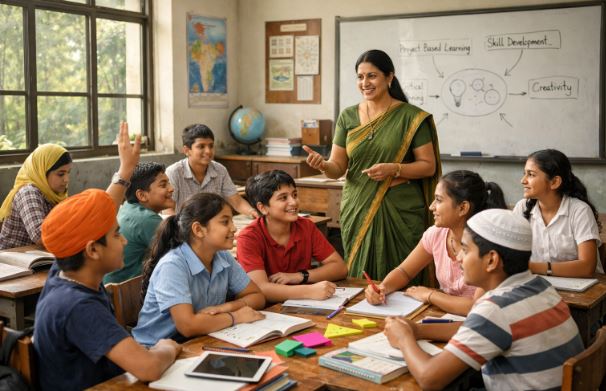
Education plays a decisive role in shaping a nation’s future, and India recognised the urgent need to modernise its education system in response to global changes, technological growth, and evolving workforce demands.
The National Education Policy 2020 was introduced to address long standing structural issues while preparing learners for a knowledge driven economy.
Replacing the National Policy on Education 1986, this policy proposes a learner centric, inclusive, and flexible framework that covers education from early childhood to higher education.
The policy aims to move away from content heavy and exam focused learning towards conceptual understanding, creativity, and skill development. It also places strong emphasis on equity, access, quality, and accountability, ensuring that education becomes a tool for social transformation as well as economic growth
Why Did India Need a New Education Policy in 2020?

India’s education system had remained largely unchanged for more than three decades, despite rapid global and domestic changes. The previous policy framework struggled to address issues such as rote learning, rigid subject boundaries, limited focus on skills, and unequal access to quality education.
Systemic Challenges Before 2020
The education system faced several limitations that affected learning outcomes and employability. These included outdated curricula, lack of multidisciplinary exposure, minimal vocational training, and high dropout rates at secondary and higher education levels. Teacher training systems also needed reform to match modern pedagogical needs.
Alignment With Global and National Priorities
India’s demographic advantage required an education system that could nurture innovation, research, and entrepreneurship. The National Education Policy 2020 was designed to align education with sustainable development goals, digital transformation, and India’s aspiration to become a global knowledge leader.
What Is National Education Policy 2020?
The National Education Policy 2020 is a comprehensive framework that redefines the purpose, structure, and delivery of education in India. It covers school education, higher education, professional learning, and adult education under a single integrated vision.
Core Principles of NEP 2020
The policy is guided by principles such as flexibility, multidisciplinary learning, respect for diversity, and ethical values. It emphasises learning outcomes over content completion and encourages students to explore interests across science, arts, humanities, and vocational fields.
Holistic Development Focus
NEP 2020 views education as a means to develop cognitive, emotional, social, and ethical capacities. By integrating Indian knowledge systems with modern education, the policy seeks to create globally competent yet culturally grounded citizens.
How Does National Education Policy 2020 Transform School Education?
School education reforms form the foundation of the National Education Policy 2020. The policy introduces structural and pedagogical changes to improve early learning and reduce dropout rates.
The 5 3 3 4 Structure
The traditional 10 plus 2 structure is replaced with a developmental model aligned with children’s cognitive stages. Early childhood education is formally integrated, ensuring strong foundational literacy and numeracy.
Curriculum and Language Reforms
Curriculum content is streamlined to allow deeper understanding and application. Teaching in the mother tongue or regional language in early grades improves comprehension and participation, especially for first generation learners.
What Changes Does NEP 2020 Bring to Curriculum and Assessment?

Assessment reforms under NEP 2020 aim to reduce exam pressure and promote meaningful evaluation.
Competency Based Learning
The curriculum focuses on core concepts, critical thinking, and real life application. Students are encouraged to question, explore, and analyse rather than memorise information.
Assessment Transformation
Examinations are redesigned to test understanding and skills. Continuous assessment becomes central to tracking progress, while national assessment bodies support standardisation and quality improvement.
Important focus areas include:
- Conceptual clarity
- Application oriented questions
- Continuous feedback for learners
How Does National Education Policy 2020 Reform Higher Education in India?
Higher education reforms seek to make Indian institutions globally competitive and learner friendly.
Multidisciplinary and Flexible Degrees
Students are allowed to move across disciplines and institutions with ease. Multiple exit options provide academic flexibility and reduce dropout related disadvantages.
Research and Institutional Governance
The policy promotes research culture through dedicated funding and institutional autonomy. A simplified regulatory structure improves accountability while encouraging innovation.
What Role Do Teachers and Digital Education Play in NEP 2020?
Teachers are recognised as the cornerstone of educational reform under NEP 2020.
Teacher Education Reforms
A four year integrated teacher education programme becomes the standard, supported by continuous professional development. Teachers receive greater autonomy and reduced administrative burden.
Digital and Technology Enabled Learning
Technology is leveraged to expand access, improve quality, and support blended learning. Digital platforms enable teacher training, online resources, and multilingual content delivery, helping bridge geographical and social gaps.
What Is the Long Term Impact of the National Education Policy 2020 on India?

The National Education Policy 2020 has far reaching implications for India’s social and economic development.
Human Capital and Employability
By integrating skills, vocational training, and multidisciplinary learning, the policy enhances employability and entrepreneurship. Learners become adaptable to changing job markets.
Equity and National Development
Targeted support for disadvantaged groups promotes inclusive growth. Over time, the policy contributes to innovation, research output, and India’s global educational standing.
Conclusion
The National Education Policy 2020 represents a transformative shift in India’s approach to education. By focusing on holistic development, flexibility, and inclusion, it lays a strong foundation for future generations.
While implementation challenges remain, sustained commitment and collaboration can ensure that the policy fulfils its vision of creating an equitable, skilled, and knowledge driven society.
FAQs
How is National Education Policy 2020 different from earlier education policies?
It focuses on holistic development, multidisciplinary learning, and skill based education rather than rote memorisation.
Does NEP 2020 make vocational education compulsory?
Vocational exposure is encouraged from middle school onwards but remains flexible and student centric.
Will board examinations be removed under NEP 2020?
Board exams continue but are redesigned to assess understanding and competencies.
How does NEP 2020 benefit rural and disadvantaged students?
It improves access through digital learning, regional language instruction, and targeted financial support.
What is the long term goal of National Education Policy 2020?
The long term goal is to build a knowledgeable, ethical, innovative, and globally competitive society.