
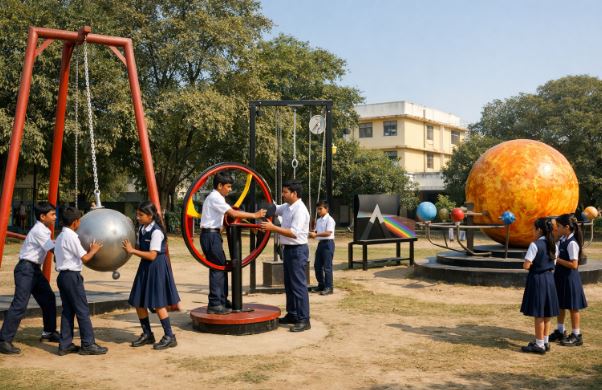
Science education becomes more meaningful when students see concepts working in real life. Many schools in India are now moving beyond traditional laboratories and adopting outdoor science parks to make learning more interactive and engaging.
A science park transforms open space into a practical learning zone where students can touch, observe and experiment with physics models. Instead of only reading about Newton’s laws or angular momentum in textbooks, learners experience these principles directly.
VAPS Science Park Solution brings together carefully designed interactive models that help schools convert theoretical lessons into hands on experiences.
Covering mechanics, optics, waves, astronomy and motion, these open air installations promote scientific literacy and curiosity. This article explains what physics models are included in a science park and how they support practical education in 2026 and beyond.
What Physics Models Are Included in a Science Park?
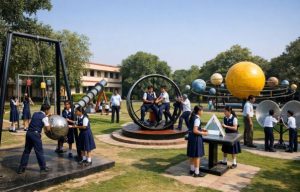
A science park includes a wide range of physics models that demonstrate core scientific principles through interaction. These models are installed in outdoor spaces, allowing students to explore science freely outside the classroom.
VAPS Science Park Solution offers more than 30 interactive models designed for schools. These models cover topics such as mechanics, optics, sound, motion, astronomy and energy transfer. Students can experiment with pendulums, gyroscopes, pulleys, prisms and solar system models in a practical environment.
Core Categories of Models
- Mechanics based models
- Optics and light experiments
- Sound and wave demonstrations
- Astronomy installations
- Motion and perception models
By interacting with these installations, students understand how theoretical physics applies to daily life. The science park acts as an open laboratory that complements classroom teaching and strengthens conceptual clarity.
How Do Mechanics Models Like Angular Momentum, Lever and Pulley Enhance Practical Physics Learning?
Mechanics models form the foundation of most science parks. These installations demonstrate force, motion, gravity and rotational dynamics in a simple and observable manner.
Models such as the 3 D Pendulum, Resonant Pendulums and Wave Pendulum help students understand periodic motion and oscillation. The Angular Momentum model and Gyroscope show how rotating bodies maintain stability.
Archimedes Screw explains fluid movement, while the Inclined Plane and Loop the Loop demonstrate gravitational force and acceleration.
Key Mechanics Installations
- Principle of Lever
- Wheel and Axle
- Weight and Pulley
- Centrifugal Force model
- Newton’s 3rd Law model
When students pull, rotate or balance these models, they observe real time results. This hands on exposure strengthens their understanding of Newtonian physics and builds analytical thinking skills.
How Do Optics and Light Based Science Park Models Demonstrate Real World Physics Concepts?
Optics models in a science park help students understand light, colour and reflection in a practical way. Instead of only studying diagrams, learners directly observe how light behaves.
The Spectrum from Crystal Glass Prism demonstrates dispersion of light. Newton’s Colour Disc and Colour Contrast models show how colours blend and separate. Mirrors including concave and convex types explain reflection and image formation. Cube Optical Illusion and other optical illusion panels highlight how perception can differ from reality.
Important Optics Models
- Prism and spectrum experiment
- Sun Filters
- Vertical Sun Dial
- Equatorial Sun Dial
- Samrat Yanthra
These models connect physics with astronomy and environmental science. By observing shadows and light angles, students understand Earth’s rotation and time measurement practically.
How Do Sound, Wave and Motion Models in a Science Park Explain Scientific Principles?
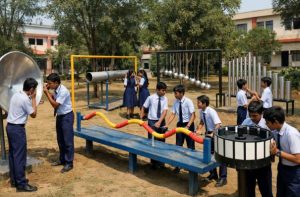
Sound and wave models make abstract wave theory easier to understand. The Echo Tube demonstrates sound reflection, while the Noise Resonator and Musical Pipes explain frequency and resonance.
Parabolic Dishes allow students to experience focused sound transmission. The Transverse Waves model visually explains wave motion. Persistence of Vision and Stroboscope installations demonstrate how the human eye perceives movement.
Motion Perception models show how visual illusions are created through movement. These installations encourage curiosity and experimentation.
Learning Outcomes from Wave Models
- Students learn about vibration
- They understand resonance and frequency
- They connect physics concepts with real world sound behaviour
These experiences build deeper conceptual clarity compared to textbook learning alone.
Why Is a Scale Model of the Solar System Important in a School Science Park?
Astronomy models add a powerful visual dimension to science parks. The Scale Model of the Solar System with a large sun diameter helps students understand planetary distances and proportions.
Traditional classroom charts cannot effectively show the vastness of space. In contrast, an outdoor solar system installation allows students to walk between planetary models and visualise scale differences.
Additional astronomical instruments such as Naadivalaya and Dakshinottara Bhitti introduce traditional time measurement systems. Sun dial models demonstrate how ancient civilisations calculated time using sunlight.
This combination of modern and traditional astronomy installations helps students appreciate both scientific evolution and practical observation skills.
How Does VAPS Science Park Solution Transform Outdoor Spaces into Interactive Science Laboratories?
VAPS Science Park Solution is designed to convert unused school spaces into vibrant learning environments. It offers customisable packages such as Silver, Gold and Platinum, allowing schools to choose models according to their needs and budgets.
Key Features
- 30 plus interactive models
- Durable equipment suitable for Indian weather
- Minimal maintenance requirements
- Complete faculty training
- Dedicated support and repair assistance
- Study materials for theoretical mapping
The flexibility in package selection ensures that schools of different sizes can implement science parks effectively. Training support helps teachers integrate these models into regular lesson plans.
What Are the Key Features and Benefits of Installing Science Park Models in Indian Schools?
Installing science park models offers multiple educational advantages. It promotes experiential learning and improves student engagement. During leisure time, students naturally gather around interactive installations, which encourages informal learning.
Science parks also support curriculum objectives by strengthening practical knowledge in mechanics, optics and astronomy. Customisation ensures alignment with CBSE and other academic frameworks.
Major Benefits
- Promotes scientific literacy
- Encourages problem solving skills
- Makes learning enjoyable
- Enhances retention of concepts
- Develops curiosity and innovation
By combining theory with real life demonstration, science parks prepare students for STEM based careers and higher education in science and technology.
Conclusion
Understanding what physics models are included in a science park helps schools realise the value of experiential education. From mechanics models like angular momentum and lever systems to optics experiments, wave demonstrations and large scale solar system installations, science parks offer a comprehensive learning environment.
VAPS Science Park Solution brings together durable, interactive and customisable models that transform outdoor spaces into open science laboratories.
By encouraging hands on exploration, these installations improve conceptual clarity and inspire scientific curiosity among students. In 2026, practical learning environments such as science parks are becoming essential for modern education in India.
FAQs
How much space is required to set up a science park in a school?
The required space depends on the number of models selected. Even medium sized playground areas can accommodate a customised package designed according to the school’s layout.
Are science park models safe for primary and secondary students?
Yes, the models are designed with safety and durability in mind. Proper installation and teacher supervision ensure secure interaction for all age groups.
Can science park equipment withstand Indian weather conditions?
High quality materials are used to ensure resistance to heat, rain and regular outdoor exposure, making them suitable for Indian climatic conditions.
How do teachers integrate science park models into classroom teaching?
Teachers can align each model with relevant chapters in physics. Training and study materials help them connect practical demonstrations with theoretical lessons.
What factors should schools consider before choosing a science park package?
Schools should consider student strength, available space, curriculum requirements and budget. Customisable Silver, Gold and Platinum packages help institutions choose the right combination of models.