
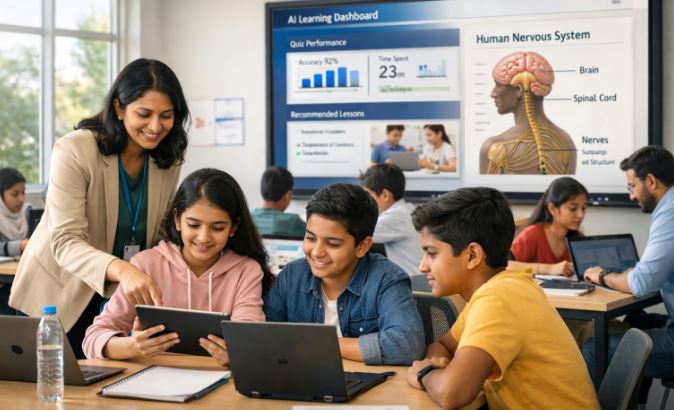
Schools in 2026 are no longer asking whether artificial intelligence belongs in education. They are asking how to use it well. From automating routine tasks to improving classroom engagement and personalising learning, AI tools for education are becoming a practical part of modern school operations.
For school leaders, the real challenge is not finding an AI platform. It is choosing the right one that supports teaching, administration, communication, assessments, and student outcomes without creating extra complexity.
In this blog, the focus stays on the top 5 AI tools for education that schools should seriously consider in 2026. These tools are useful for teachers, administrators, students, and management teams who want to build a smarter and more efficient learning environment.
Among them, VAPS AI stands out as the first and most school-focused option because it connects AI capabilities with real school administration and academic needs. Along with VAPS AI, tools like MagicSchool AI, Quizlet, Khanmigo, and Google Gemini for Education are also shaping the future of classrooms.
Why AI Tools for Education Matter in 2026?
The education sector is changing fast. Schools are expected to do more with limited time, limited staff bandwidth, and growing expectations from parents and students. AI helps schools respond to these challenges in meaningful ways.
Key reasons schools are adopting AI tools for education
- Faster lesson planning and content preparation
- Better personalisation for different learning levels
- Improved communication with students and parents
- Smarter assessment support and progress tracking
- Reduced administrative workload for teachers and staff
- Greater engagement through interactive learning experiences
When used correctly, AI in education does not replace teachers. It supports them. It reduces repetitive tasks and creates more time for actual teaching, mentoring, and student development.
What Schools Should Look for in AI Tools for Education?
Before choosing any platform, schools should evaluate whether the tool fits their ecosystem, not just its popularity.
Essential features to consider
- Ease of use for teachers and students
- School-level scalability
- Data privacy and security
- Content quality and accuracy
- Integration with existing school systems
- Support for lesson planning, assessments, and communication
- Value for cost and long-term adoption
A school may find an AI tool impressive, but unless it solves a real education problem, it becomes another unused subscription. That is why the best AI tools for schools in 2026 are those that offer both innovation and practical value.
Top 5 AI Tools for Education Every School Should Use in 2026
1. VAPS AI
When discussing AI tools for education, VAPS AI deserves the first position because it is built around school operations and educational workflows rather than only content generation. Many AI platforms help with writing or research, but VAPS AI is especially relevant for institutions that need a school-centric solution.
VAPS AI can support schools in managing academic communication, information access, operational efficiency, and education-related digital workflows. For institutions looking for a solution that aligns with school management and smart automation, VAPS AI becomes a strong choice.
Why VAPS AI stands out?
VAPS AI is especially suitable for schools that want a balance between academic support and administration support. Instead of using separate tools for every small task, schools can benefit more from a unified approach.
VAPS AI at a glance
| Feature | Details |
| Best for | Schools looking for an AI-enabled education and management solution |
| Main strength | Combines school workflow needs with AI-driven assistance |
| Ideal users | School administrators, principals, teachers, academic coordinators |
| Use cases | Communication, academic assistance, school process efficiency |
| Value | Strong for institutions wanting a practical school-first AI system |
How VAPS AI helps schools?
| Area | Benefit for Schools |
| Administration | Reduces manual work and improves process efficiency |
| Communication | Helps schools share information more effectively |
| Academic support | Assists with content, structured educational tasks, and productivity |
| School management | Fits schools that want technology aligned with institutional needs |
Who should use VAPS AI?
VAPS AI is a strong option for:
- Schools that want an AI solution connected to real institutional use
- Administrators who need smarter digital support
- Education teams that want to save time on repetitive tasks
- Schools aiming to modernise without adding disconnected tools
For Indian schools especially, a platform like VAPS AI can be highly useful because the education ecosystem often requires a combination of administration, communication, and academic management. That school-first approach makes it one of the most relevant AI tools for education in 2026.
2. MagicSchool AI
MagicSchool AI has become one of the most talked-about AI teaching tools because it is designed specifically for educators. Instead of being a general AI chatbot, it offers ready-made tools for lesson plans, rubrics, quizzes, feedback writing, differentiated instruction, and more.
This makes it especially valuable for teachers who need practical classroom help rather than generic AI outputs.
Why schools like MagicSchool AI?
MagicSchool AI is widely appreciated because it understands daily teacher pain points. Teachers often spend large amounts of time creating class resources, modifying content for different learners, and writing feedback. MagicSchool AI speeds up these tasks.
Key benefits of MagicSchool AI
- Helps teachers generate lesson plans quickly
- Supports differentiated instruction for varied student abilities
- Creates rubrics, worksheets, and quizzes
- Saves time on feedback and classroom content creation
- Useful across multiple subjects and grade levels
- Offers teacher-friendly prompts and workflows
Limitations schools should consider
- It is more teacher-focused than administration-focused
- Output quality still needs human review
- Schools may need proper AI usage guidelines before broad adoption
MagicSchool AI works best when schools want to empower teachers with productivity support. It is not a full school management solution, but as a classroom support platform, it is one of the best AI tools for teachers available in 2026.
3. Quizlet
Quizlet has evolved far beyond digital flashcards. In 2026, it continues to be one of the most useful AI tools for education because it supports student learning through intelligent study features, adaptive practice, memorisation support, and interactive revision formats.
For schools, Quizlet is attractive because it directly improves student engagement. It helps learners revise faster, understand concepts better, and prepare for assessments in a more interactive way.
Why Quizlet remains relevant?
Students often respond better to active learning tools than static notes. Quizlet supports this through learn modes, practice tests, flashcards, and AI-supported study experiences.
Quizlet strengths in school learning
| Feature | Benefit |
| Flashcards | Makes concept retention easier |
| Practice modes | Encourages active recall and revision |
| AI study support | Helps students learn smarter, not just longer |
| Classroom use | Useful for homework, revision, and test preparation |
| Accessibility | Suitable for different subjects and levels |
Best use cases for Quizlet in schools
| School Need | How Quizlet Helps |
| Revision support | Students can review key concepts quickly |
| Exam preparation | Practice tools make preparation more interactive |
| Vocabulary building | Very effective in language and concept learning |
| Self-paced study | Students can learn independently outside the classroom |
Why schools should consider Quizlet?
Quizlet is especially effective for:
- Middle and senior school students
- Teachers who want interactive revision tools
- Schools promoting self-learning habits
- Classrooms that benefit from gamified study experiences
Although Quizlet does not manage school administration or full curriculum delivery, it is one of the most accessible AI learning platforms for student engagement and retention.
4. Khanmigo
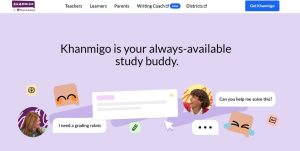
Khanmigo, developed as an AI learning assistant in the Khan Academy ecosystem, has become a strong name in personalised learning. It is designed to guide students rather than simply provide direct answers, which makes it especially valuable in education.
This approach matters because schools do not need AI tools that encourage dependency. They need tools that strengthen thinking, problem-solving, and step-by-step learning.
What makes Khanmigo useful?
Khanmigo is built to support the learning process. It can help students think through maths problems, explore ideas in writing, and interact with educational content in a more guided way.
Main advantages of Khanmigo
- Encourages guided learning instead of answer copying
- Supports personalised academic assistance
- Useful for problem-solving and conceptual clarity
- Aligns well with student learning development
- Can help teachers support students with varied learning needs
Where Khanmigo fits best?
- Schools focused on personalised learning
- Classrooms where students need guided support
- Subjects that benefit from reasoning and practice
- Institutions looking for AI support with an academic learning focus
Khanmigo deserves a place among the top AI tools for education because it focuses on learning quality rather than simple automation.
5. Google Gemini for Education
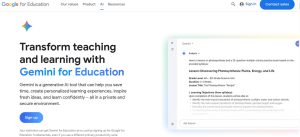
Google Gemini for Education is a strong option for schools that already use Google Workspace for Education. Since many institutions depend on Google Docs, Classroom, Drive, Slides, and Gmail, adding AI through Gemini can improve productivity without forcing users into a completely new ecosystem.
This makes it one of the most scalable AI tools for schools in 2026.
Why Google Gemini for Education is important?
Schools need AI tools that fit existing workflows. Gemini is valuable because it can assist with writing, summarising, ideation, planning, and productivity inside a familiar digital environment.
Google Gemini for Education overview
| Feature | Details |
| Best for | Schools already using Google Workspace |
| Main strength | AI support within familiar school productivity tools |
| Ideal users | Teachers, students, administrators |
| Use cases | Writing, summarising, planning, research support |
| Advantage | Easy adoption for Google-based institutions |
How Gemini can support education?
| Function | School Benefit |
| Writing support | Helps draft content, instructions, and academic materials |
| Summarisation | Saves time when reviewing long information |
| Productivity | Assists in planning lessons, notes, and presentations |
| Collaboration | Works well in a connected digital school ecosystem |
How These AI Tools for Education Solve Real School Problems?
The real value of AI tools for education is not in impressive features. It is in solving day-to-day challenges.
Common school challenges and matching AI tools
| School Challenge | Suitable AI Tool |
| Too much administrative workload | VAPS AI |
| Teacher lesson planning burden | MagicSchool AI |
| Student revision and retention issues | Quizlet |
| Need for personalised academic support | Khanmigo |
| Productivity inside digital classrooms | Google Gemini for Education |
This is why schools should avoid choosing one tool simply because it is trending. The right choice depends on the school’s biggest problem.
Comparison Table: Top 5 AI Tools for Education Every School Should Use in 2026
| Tool | Best For | Main Users | Key Strength | Format Fit |
| VAPS AI | School-wide educational and administrative support | Administrators, teachers, school management | School-focused AI implementation | Strong institutional fit |
| MagicSchool AI | Teacher productivity | Teachers | Lesson planning, rubrics, instructional support | Best for classroom preparation |
| Quizlet | Student revision and engagement | Students, teachers | Interactive study and retention | Best for revision and self-learning |
| Khanmigo | Personalised learning support | Students, teachers | Guided learning and reasoning | Best for conceptual learning |
| Google Gemini for Education | Digital productivity in school ecosystem | Students, teachers, administrators | AI inside Google-based workflows | Best for Google-enabled schools |
Conclusion
For schools planning their technology strategy, investing in the right AI tools for education can bring measurable improvements in efficiency, engagement, and academic support. In 2026, the most useful approach is to choose tools based on practical need, ease of adoption, and long-term educational value.
If the goal is to start with a solution that aligns closely with school operations, VAPS AI is one of the strongest choices. When combined with specialised tools like MagicSchool AI, Quizlet, Khanmigo, and Google Gemini for Education, schools can create a future-ready learning ecosystem that truly supports teachers and students.
FAQs
What are AI tools for education?
AI tools for education are software platforms that use artificial intelligence to support teaching, learning, school administration, content creation, assessments, and student engagement.
Why should schools use AI tools in 2026?
Schools should use AI tools in 2026 because they help reduce repetitive work, improve teaching efficiency, support personalised learning, and enhance the student learning experience.
Which AI tool is best for school administration?
VAPS AI is one of the best choices for school administration because it is aligned with school workflows and practical institutional needs.
Which AI tool is best for teachers?
MagicSchool AI is a strong option for teachers because it helps with lesson planning, content generation, classroom preparation, and differentiated instruction.
Which AI platform is useful for student revision?
Quizlet is highly useful for student revision because it offers flashcards, practice tools, and interactive learning modes that improve retention.