
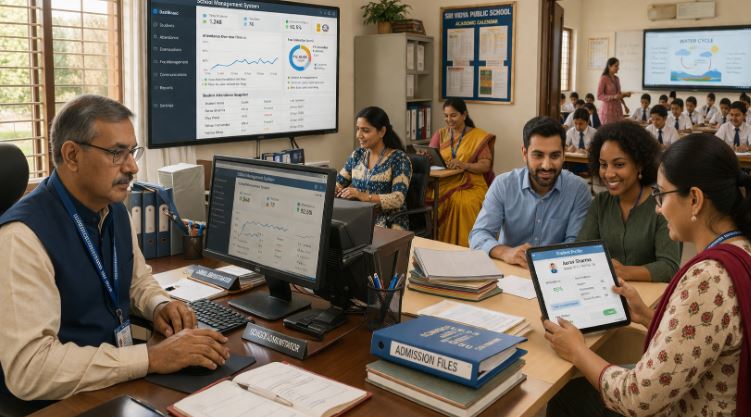
In today’s fast-evolving education landscape, how can schools efficiently manage academics, administration, and communication all in one place? This is where School ERP software becomes a game-changer. Schools worldwide are increasingly adopting ERP systems to streamline operations, reduce manual workload, and enhance productivity.
From automating daily tasks to improving transparency among stakeholders, ERP solutions offer numerous advantages. In this blog, we explore the top 10 benefits of School ERP software and how it transforms modern educational institutions globally.
1. Streamlined Administrative Processes
School ERP software simplifies complex administrative tasks such as admissions, attendance, timetable scheduling, and fee management. Instead of handling paperwork manually, administrators can manage everything from a centralized dashboard. This reduces redundancy and minimizes errors while saving time.
With automation, schools can operate more efficiently and allocate resources effectively. Additionally, staff can focus on strategic tasks rather than routine paperwork, improving overall institutional productivity and workflow management.
2. Improved Communication
Effective communication is crucial for any educational institution. ERP systems bridge the gap between teachers, students, parents, and administrators through instant notifications, emails, and portals. Parents can track their child’s performance, attendance, and school activities in real time.
Teachers can easily share updates, assignments, and feedback. This seamless communication builds transparency, strengthens relationships, and ensures everyone stays informed, ultimately contributing to better student outcomes.
3. Efficient Data Management
Managing vast amounts of student and institutional data manually can be overwhelming. School ERP software securely stores and organizes data in one place, making retrieval quick and easy.
From academic records to financial reports, everything is accessible with just a few clicks. This not only enhances efficiency but also ensures data accuracy. Additionally, cloud-based ERP systems provide data backup and security, protecting sensitive information from loss or unauthorized access.
4. Enhanced Academic Performance Tracking
ERP systems allow teachers to monitor student performance through detailed reports and analytics. They can track grades, attendance, and participation to identify strengths and weaknesses.
This helps in providing personalized support to students who need improvement. Parents also gain insights into their child’s progress, enabling better collaboration with teachers. Ultimately, this data-driven approach leads to improved academic outcomes and student success.
5. Time and Cost Efficiency
By automating repetitive tasks, School ERP software significantly reduces the time and effort required for administrative work. Schools can cut down on paperwork, printing, and manual labor costs. Additionally, faster processes mean better resource utilization.
Over time, this leads to substantial cost savings while increasing operational efficiency. Institutions can invest these savings into improving infrastructure and educational quality.
6. Better Attendance Management
Tracking attendance manually is time-consuming and prone to errors. ERP systems automate attendance recording using digital tools, ensuring accuracy and real-time updates. Teachers can mark attendance quickly, and parents receive instant notifications about absences.
This helps in maintaining discipline and identifying attendance patterns. Schools can also generate reports for analysis, making attendance management more efficient and reliable.
7. Simplified Fee Management
Fee collection and tracking can be challenging without proper systems in place. School ERP software streamlines fee management by automating invoicing, payment tracking, and receipt generation.
Parents can pay fees online, making the process convenient and hassle-free. Schools can also monitor pending payments and generate financial reports easily. This ensures transparency and reduces financial discrepancies.
8. Customizable and Scalable Solutions
Every school has unique requirements, and ERP software offers customizable features to meet those needs. Whether it’s a small institution or a large educational network, ERP systems can scale accordingly.
Schools can choose modules based on their requirements and expand as they grow. This flexibility ensures long-term usability and adaptability to changing educational demands.
9. Real-Time Reporting and Analytics
ERP systems provide real-time insights through dashboards and reports. Administrators can analyze data related to academics, finance, and operations to make informed decisions.
These insights help in identifying trends, improving strategies, and enhancing overall performance. With accurate data at their fingertips, school leaders can plan effectively and drive institutional growth.
10. Increased Transparency and Accountability
Transparency is essential for building trust among stakeholders. School ERP software ensures that all activities, records, and transactions are documented and accessible.
Parents, teachers, and administrators can view relevant information anytime. This accountability reduces misunderstandings and promotes a culture of trust and efficiency within the institution.
Conclusion
School ERP software has become an essential tool for modern educational institutions worldwide. By integrating various functions into a single platform, it simplifies operations, enhances communication, and improves overall efficiency. From better data management to increased transparency, the benefits are undeniable.
As schools continue to embrace digital transformation, adopting ERP solutions is no longer an option but a necessity. Investing in the right ERP system can significantly improve educational quality and institutional success in the long run.
FAQs
What is School ERP software?
School ERP software is a digital system that manages academic, administrative, and financial operations in one platform.
How does ERP improve school efficiency?
It automates routine tasks, reduces manual work, and streamlines processes, saving time and resources.
Is School ERP software secure?
Yes, most ERP systems offer data encryption and secure cloud storage to protect sensitive information.
Can parents access ERP systems?
Yes, parents can log in to track attendance, grades, and communicate with teachers easily.
Is ERP suitable for small schools?
Absolutely, ERP systems are scalable and can be customized to fit the needs of small institutions.